What is a herniated disc? What are the effects of Pilates on a herniated disc?


A herniated disc is a condition that occurs when the structure of the discs between the vertebrae deteriorates, causing the gel-like substance inside to protrude outwards. If this protrusion puts pressure on the nerves exiting the spinal cord, it can lead to symptoms such as pain, numbness, and weakness .
How does it form, in short?
Spinal discs consist of two parts:
Nucleus pulposus: The soft, gel-like inner part.
Annulus fibrosus: The tough outer ring surrounding this gel.
When the outer ring weakens or tears, the inner part protrudes outwards → a lumbar disc herniation occurs.
Symptoms
Lower back pain (often radiating to the hip and leg)
Numbness and tingling in the leg.
Loss of strength in a leg or foot
Pain increases when leaning forward or sitting for long periods.
Pain increases with coughing and sneezing.
Reasons
Overloading, incorrect lifting
Working while sitting for long periods of time
Sudden movements or trauma
Disc degeneration with age
Obesity
Weak waist and abdominal muscles
How is the treatment carried out?
Treatment often does not require surgery.
Rest and medication
Physiotherapy
Waist and core exercises (Pilates)
Hot/cold applications
Injection treatments (if needed)
Surgery: This should be considered if there is severe nerve compression or if there is no improvement despite treatment.

Benefits of Pilates
Pilates, when practiced correctly, can be quite beneficial for many people with herniated discs. Its most important effect is strengthening the muscles that support the spine and reducing the pressure on the disc. Below you can find the most important benefits in a simplified way:
✅ Benefits of Pilates for Herniated Disc
1. Strengthens core (abdominal and lower back) muscles.
One of the most important causes of herniated discs is weakness in the muscles that support the spine.
Pilates safely strengthens these muscles → reduces the pressure the herniated disc puts on the nerve → relieves pain.
2. Corrects spinal posture.
Poor posture (slouching, constantly leaning forward on the lower back) puts pressure on the disc.
Pilates improves posture awareness and corrects spinal alignment.
3. Reduces tension around the waist.
Muscle spasms are one of the main causes that increase pain in lumbar disc herniation.
The controlled and gentle stretching movements in Pilates reduce tension.
4. Increases mobility.
The stiffening of the lower back and hips due to a herniated disc can restrict movement over time.
Pilates increases flexibility, making everyday movements easier.
5. Reduces the load on the lower back.
With proper breathing and movement control, the spine moves in a more protected manner.
This also reduces strain on the back during daily life.
6. It can reduce the likelihood of surgery.
Regular and proper Pilates practice can control symptoms in many patients and reduce the need for surgery (depending on the specific case).
⚠️ Things to watch out for
❌ Not every Pilates exercise is suitable for herniated discs.
A wrong move can worsen a hernia.
Especially:
Excessive lumbar lordosis (hyperextension)
Strong twisting (sudden rotation)
Rapid leg raising/lowering
Reverse movements
Such actions should be avoided.
👉 Ideally: To do this under the guidance of a physical therapist or a clinical Pilates or spinal Pilates instructor.
SAFE "DO" EXERCISES FOR LUMBAR DISC HERNIATION
The following exercises strengthen the core and surrounding muscles without putting strain on the spine.
1) Pelvic Tilt (Pelvic Clock / Pelvic Rotation)
Objective: To activate abdominal muscles and reduce tension in the lower back.
How to do it:
Lie on your back with your knees bent.
Gently press your lower back down towards the floor, then release.
10–12 repetitions.
2) Dead Bug (Modified)
Objective: Core stability
How to do it:
Lie on your back, knees at a 90-degree angle, arms raised.
Lower your right arm backward while slowly extending your left leg → then switch.
The lumbar region must be protected.
8–10 repetitions.
3) Cat-Cow
Objective: Spinal mobility
How to do it:
In a four-legged position, alternately round and slightly arch your back (without overdoing it).
10–15 repetitions.
4) Bridge (Modified Bridge)
Objective: To strengthen the muscles around the hips and waist.
How to do it:
Lie on your back with your knees bent.
Slowly lift your hips → a straight line from your shoulders to your knees.
6–10 repetitions.
5) Child's Pose
Objective: To reduce tension in the lower back.
How to do it:
Sit on your knees, extending your arms forward.
Hold your breath comfortably for 20-30 seconds.
6) Side-lying Leg Raises
Objective: To strengthen the oblique hip muscles and reduce strain on the lower back.
How to do it:
Lie on your side and slowly raise and lower your upper leg.
10 repetitions.
COMMON AVOIDABLE MOVEMENTS IN LUMBAR DISC HERNIATION
These movements can increase disc pressure or worsen nerve compression.
❌ 1) “Swan” and “Cobra” style backstretchings that excessively arch the back
It compresses the lumbar vertebrae.
❌ 2) Crunch / Sit-ups
It significantly increases disc pressure.
❌ 3) Rolling forward while bending over (Roll Up, Roll Over)
It puts strain on the disc herniation.
❌ 4) Sudden or wide waist twists (Spine Twist – classic)
It can increase irritation in the nerve root.
❌ 5) Straight Leg Raise (quick/sudden)
It puts strain on the lower back area.
RECOMMENDED REFORMER PILATES EXERCISES FOR LUMBAR DISC HERNIATION

1) Footwork (with a neutral spine)
Benefits: Strengthens leg and hip muscles, reduces strain on the lower back.
Important: The pelvis should be in a neutral position, without increasing the curve of the lower back.

2) Leg Circles (With foot slings – small angle)
Benefit: Increased hip mobility, reduced strain on the lower back.
Modification: The circles are kept small, and the pelvis is stabilized.

3) Bridging on Reformer (Modified)
Benefit: Strengthens the gluteus and hamstrings → reduces pressure on the lower back.
Important: This should only be done if there is no back pain; do not lift too high.
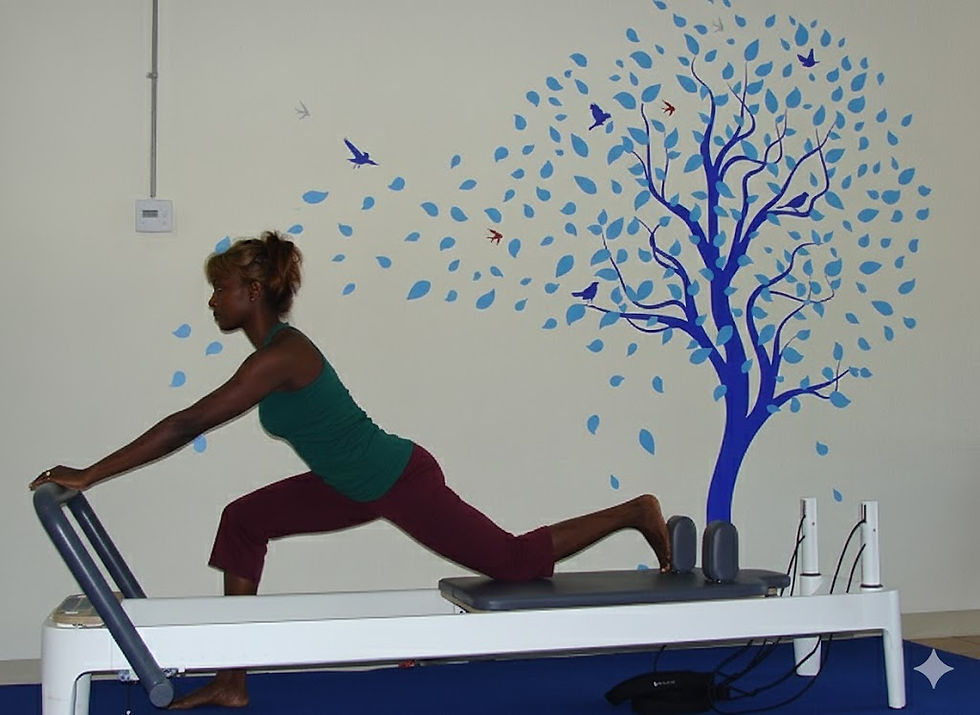
4) Eve's Lunge (Hamstring and hip flexor stretch)
Benefit: It relieves lower back pain by reducing hip flexor tension.
Modification: Torso upright, without arching of the lower back.

5) Mermaid Stretch
Benefit: Gently stretches the oblique lower back muscles (quadratus lumborum) and the spine.
This is one of the most relieving exercises for a herniated disc.

6) Feet in Straps – Frogs
Benefits: Improves hip stability; places minimal strain on the lower back.
Modification: Performed without opening the knees and hips too much.
7) Arms Series (Sitting or Kneeling — with stable core)
Benefits: Improves spinal stability and activates core muscles.
Modification: Backrest in an upright and neutral position.
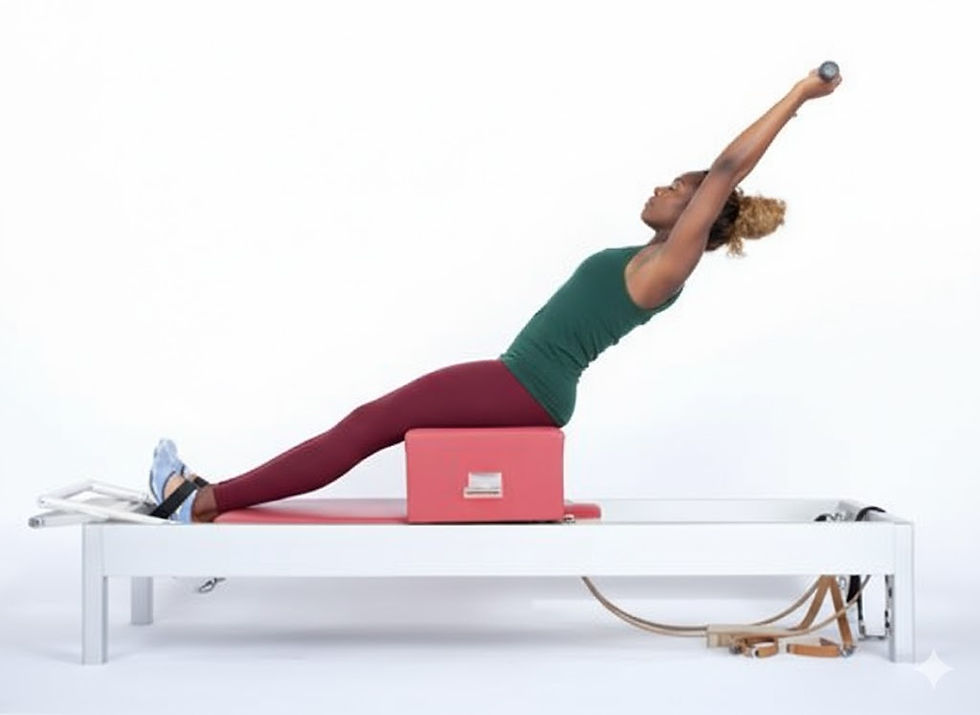
8) Short Box – Flat Back instead of Round Back
Benefit: Increased trunk stability.
Important: Round back (forward rolling) is not recommended for herniated discs → Flat back is performed.
9) Standing Leg Press
Benefits: Strengthens hip muscles and reduces strain on the lower back.
Modification: Small gap, spine stability.
REFORMER EXERCISES TO AVOID IN LUMBAR DISC HERNIATION
These movements can increase disc pressure:
Long Stretch Series (Plank variations) → May strain the back muscles.
Snake & Twist → Extreme rotation
Teaser on Reformer → Intense flexion + core load
Short Spine / Long Spine → Excessive flexion in the lower back
Round Back (Short Box) → Disc pressure increases
High Bridge → Excessive lumbar extension

Points to Consider
When doing Pilates, individuals with herniated discs should pay attention to a few important points:
Doctor's Approval: It's important to get a doctor's approval before starting any exercise program. This ensures your health status is checked.
Instructor Support: Exercising with a Pilates instructor or physiotherapist ensures that correct techniques are applied and reduces the risk of injury.
Performing Movements Slowly: Doing exercises slowly and in a controlled manner prevents unnecessary strain.
Pain Sensation: If you experience pain during exercise, it's important to stop the movement and inform your instructor.
Monitoring Results
Observing the effects of Pilates on lumbar disc herniation is important for individuals' health and well-being. Along with regular exercise, improvements in the lumbar region, as well as overall body condition, should be monitored. Collaborating with instructors to create exercise plans tailored to individual needs will be beneficial.
Pilates offers an effective alternative for individuals with herniated discs. If you are also struggling with a herniated disc, don't forget to consult an expert to get detailed information about Pilates and to implement its practices!


Comments